If you run a clinic in Surrey, you already know cleaning isn’t optional. The harder question is how often. A Hamilton family doctor asked it bluntly on Reddit last year: 1,600 square feet, exam rooms, three washrooms, a 7 p.m. to 9 p.m. window. He wanted a real answer, not a glossy brochure. This post is that answer for Surrey.
We’ve been doing janitorial work across Surrey, Cloverdale, Delta, Langley and White Rock since 2013. The pattern below is what works for the medical and dental offices we serve, framed against Fraser Health Authority guidance, WorkSafeBC’s bloodborne pathogens exposure control standard, and IPAC Canada infection prevention principles.
Quick answer: a working Surrey medical office needs four overlapping cleaning rhythms.
The four cleaning rhythms every Surrey clinic needs
| Rhythm | Who does it | What gets cleaned |
|---|---|---|
| Between patients | Clinical staff (MA, hygienist, RN) | Exam table, chair, counter, all touch points, with disinfectant dwell time |
| Daily (after-hours) | Cleaning service | Waiting room, washrooms, floors, biohazard bins, reception, shared kitchen |
| Weekly | Cleaning service | Full facility detail, vent dusting, baseboards, grout, glass, storage rooms |
| Monthly or quarterly | Cleaning service | Carpet extraction, floor strip and seal, exam-light deep clean, ceiling tile inspection |
The mistake we see most often: a Surrey clinic books a single weekly visit and assumes that covers everything. It doesn’t. The post-COVID standard is layered, and skipping any one of these rhythms shows up fast in a patient-facing space.
Between patients: the part your team does, not your cleaner
Cleaning between patients belongs to clinical staff. Medical assistants and hygienists on Reddit are emphatic about what good looks like, and what doesn’t.
What gets wiped, every patient, every room:
- Exam table or dental operatory chair, including the headrest and armrests
- Counter and any shared surface the patient touched
- BP cuff, pulse oximeter, otoscope and stethoscope earpieces
- Door handle, light switch, faucet handles in the room
- Pens at reception if the patient signed in
- For dental: chair controls, suction handles, the light handle, the tray, the cuspidor
What does not work, as Surrey clinic managers and the wider medical assistant community keep repeating:
- Spraying Lysol into the air. It only disinfects what it directly contacts, and aerosolized disinfectant can trigger bronchospasm in sensitive patients.
- Wiping with a paper towel and moving on. Disinfectants have a contact time. Most hospital-grade wipes need one minute wet and one minute dry to actually kill what’s on the surface.
- Changing the paper liner and calling the room clean. That was acceptable in 2019. It isn’t now.
If you’re already doing this internally, your cleaning service starts where staff leaves off.
Daily, after the last patient: where your cleaner earns it
The Surrey clinic operators who hire us almost always start the conversation the same way. They’ve been through one or two cleaning companies that started strong and quietly degraded over the first month. The thing that gives way first is the daily routine.
For a typical Surrey medical or dental office, daily cleaning means:
- All washrooms scrubbed, restocked, mirrors cleaned, floors mopped with a hospital-grade disinfectant
- Waiting room dusted, magazines straightened, chairs wiped, high-touch points (door handles, sign-in pen area, payment terminal) disinfected with proper dwell time
- Reception desk, including phones and keyboards (the patient-facing side, especially)
- Exam room floors damp-mopped, garbage emptied, biohazard bins checked
- Staff kitchen wiped, dishes addressed if that’s in scope, garbage taken out
- Vacuuming any carpeted areas, particularly the waiting room
The 7 p.m. to 9 p.m. window most Surrey clinics need is non-negotiable. Patients arrive at 8 a.m. the next morning, and so does your reputation.
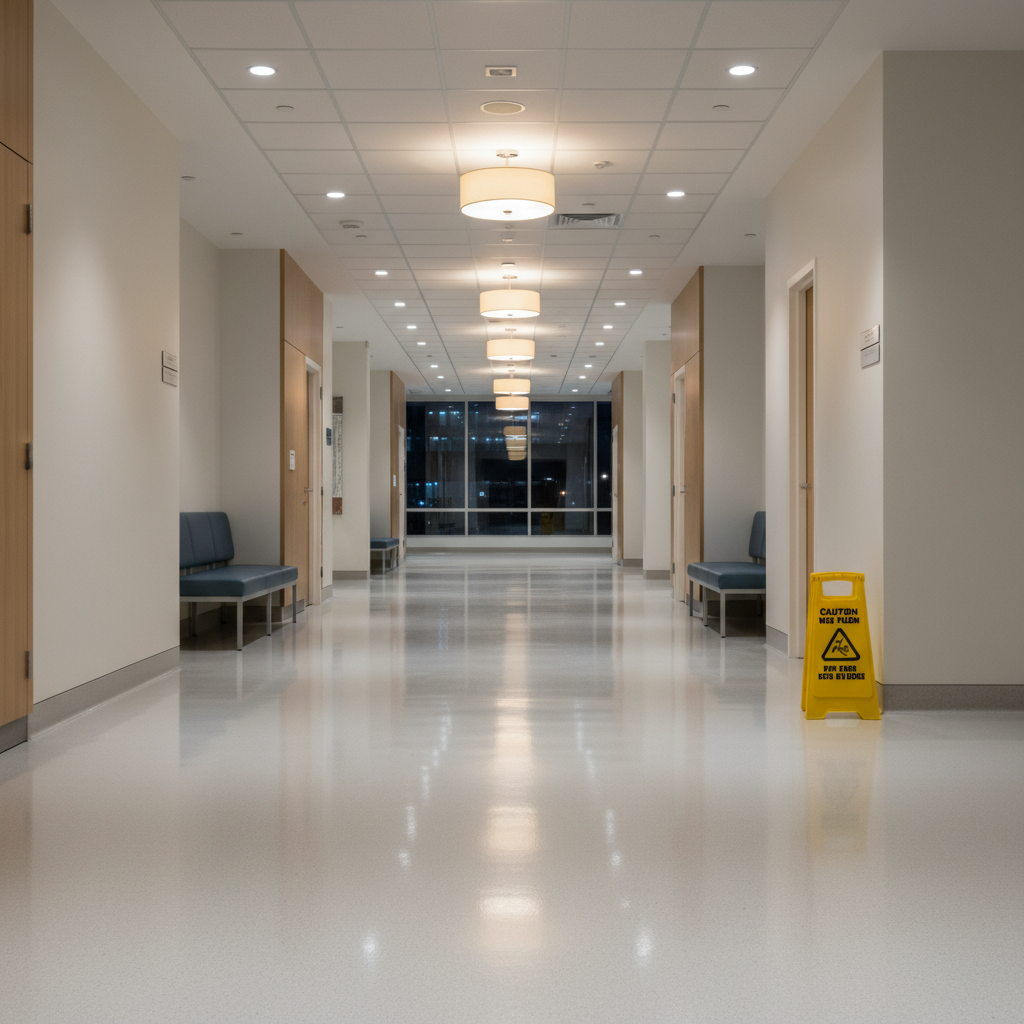
!Empty Surrey medical clinic corridor cleaned during the after-hours window
Weekly: the detail layer
Weekly cleaning catches what daily can’t. In a Surrey clinic, this usually means:
- Full washroom detail including grout, behind toilets, baseboards, and the underside of fixtures
- Vent and air register dusting (huge during fall through spring when Surrey’s rain pulls dust through the HVAC)
- Glass, partitions, and reception sneeze guards inside and out
- Storage rooms, sterilization area floors (cleaning crew works around the autoclave, not on the instruments themselves)
- Baseboards in waiting room and hallways
- Spot carpet treatment in high-traffic patches near entrances
If your cleaner is doing five visits a week, weekly tasks rotate across the visits. If you’re on a once-a-week schedule, weekly tasks are layered into that one visit, which is why a one-visit-a-week clinic needs a longer visit, not a shorter one.
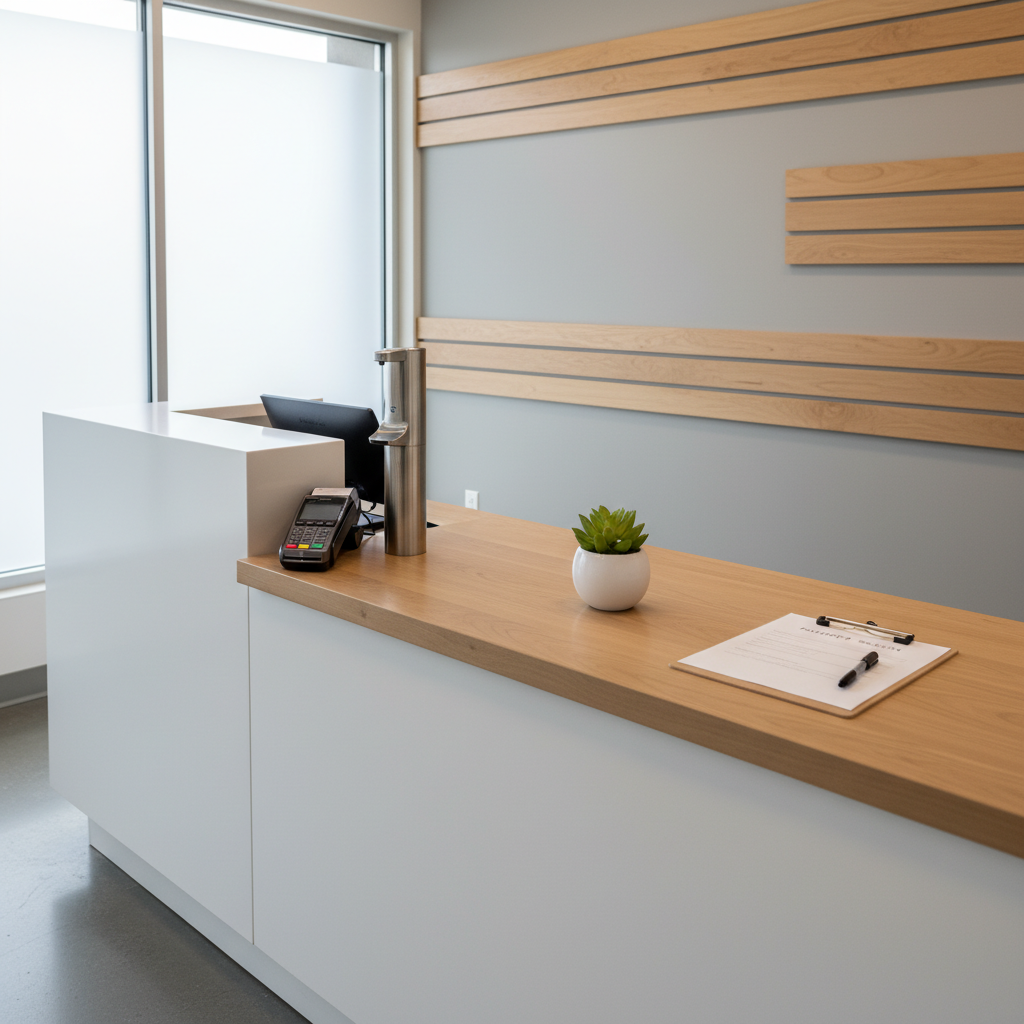
!Close detail of a tidy reception desk at a Surrey medical clinic
Monthly and quarterly: the deep work
Monthly tasks for a Surrey clinic generally include:
- Carpet extraction in waiting and reception (especially after the wet season)
- Exam-light deep clean, including the arm joints and reflector
- Cabinet face wipe-downs
- Wall spot-cleaning at chair-height (where backpacks and elbows hit)
Quarterly or semi-annual:
- Floor strip and seal in vinyl or LVT areas
- Ceiling tile inspection and replacement if any are stained
- Full hard-floor extraction in clinical zones
- A walk-through with the office manager to recalibrate the routine
We serve clinics across Newton, Fleetwood, Guildford, Cloverdale, City Centre and the South Surrey/White Rock corridor. The wet season from late October through April is the single biggest variable. Mud on entry mats, slip risk in waiting rooms, water tracked into the back of the building. Daily entrance protocols matter more here than in drier markets.
How the day-of-week schedule usually shakes out
A common Surrey medical or dental office rhythm:
- Monday: Daily clean + weekly washroom detail
- Tuesday: Daily clean
- Wednesday: Daily clean + weekly vent and dusting layer
- Thursday: Daily clean
- Friday: Daily clean + weekly carpet/floor focus, set up for the weekend
Plus a monthly walk-through on the last Friday of the month, and quarterly deep cleans scheduled in advance. Office managers we work with prefer this layered cadence over a single big weekly visit because it spreads the labour and keeps the space presentable every morning.
Surrey-specific notes that change the schedule
- Fraser Health and WorkSafeBC, not OSHA. Your cleaner should be able to talk about WorkSafeBC’s bloodborne pathogens exposure control plan and IPAC Canada infection prevention basics. If they reference OSHA or CDC instead, they’re using US training material and probably don’t know the BC compliance side.
- PIPA, not HIPAA. Same principle, different statute. Your cleaning crew works around patient records and should sign a confidentiality agreement.
- Rain season requires more entry attention. From late October through April, daily mats and lobby floors need real attention. We’ve seen Surrey clinics double their lobby cleaning frequency from October to March.
- Multi-tenant medical buildings. If you’re in a multi-clinic building near Surrey Memorial, King George Hub, or Morgan Crossing, the strata cleans the common areas. Your interior is yours. Don’t assume the strata cleaner is doing your reception.
- Independent clinic vs corporate group. If your practice is part of a buying group like 123Dentist or Dental Corp, the cleaning vendor may already be set centrally. If you’re independent, the office manager picks, and the office manager is who your cleaner answers to.
Frequently Asked Questions
Is daily cleaning really necessary, or can we go three days a week?
For a clinic with daily patient flow, daily is the right answer. Washrooms and high-touch surfaces accumulate enough biological load in 24 hours that three-day-a-week schedules consistently fail audits and patient comments. Lower-volume specialty clinics with fewer patient days sometimes work on a three or four day schedule.
Who’s responsible for cleaning between patients, the cleaner or the staff?
Between-patient cleaning is clinical staff. Your cleaner handles the after-hours daily routine, weekly detail, and the deep work. We don’t enter exam rooms while patients are in them.
What’s the difference between sanitize and disinfect?
Sanitizing reduces germs to safe levels. Disinfecting kills nearly all germs on a surface. Medical and dental offices need disinfectant, with the correct dwell time on the label, not just sanitizer.
Does Crystal Clean handle biohazard or sharps disposal?
No. Biohazard and sharps are a separate regulated vendor. We clean around it. We don’t touch the sharps containers themselves beyond moving them if needed.
How long should the daily clean of a 1,500 square foot Surrey medical office take?
Typically 90 to 120 minutes for a true daily clean with washroom detail. Faster than that and we’d worry about what’s being skipped.
Where to start
If your current schedule isn’t holding up, the fix usually isn’t more visits. It’s a layered routine with a cleaner who can talk about WorkSafeBC, dwell time, and the difference between sanitize and disinfect.
We offer free walk-throughs across Surrey, Cloverdale, Delta, Langley and White Rock. We’ll look at your space, ask about your current pain points, and quote a real schedule, not a flat number. Visit our medical office, clinic and dental cleaning page or call us to book.
5★ on Google across 41 reviews. Locally owned since 2013. Insured, bonded, WorkSafeBC covered.